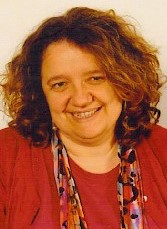
On Friday July 3rd a group of us gathered invited by a friend who will soon leave Geneva. We talked and shared stories and we threaded beads. The threading helped us to focus on our feelings, our hands had something to do and we could more easily listen to one another.
We were sad and emotions were high ...
What follows is a reflection I prepared before the evening.
Red threads and beads for a rare pearl …
In French the phrase une perle rare meaning a precious pearl, a rare jewel or stone, and it’s also a way of referring to a person. Calling someone une perle rare is a way of honouring their uniqueness, their beauty, their contribution – it’s a way too of saying they are brilliant and fabulous! ;-)
So N … this evening we celebrate your brilliance and fabulousness, how precious you have been to us in this place. To do that we have brought beads with us and some red thread.
We are going to thread our rare pearls onto le fil rouge. This phrase le fil rouge makes me smile because there’s a lot of biblical, feminist, mythical and birthing imagery in the red thread. However, it’s also very difficult to translate – “common thread” maybe the best we can do for now.
You’ll maybe remember the story from Greek mythology of Ariadne who helped Theseus escape the minotaur’s underground labyrinth by giving him a thread to follow – perhaps that thread was a red thread, or maybe a golden thread, or perhaps a prehistoric fluorescent thread that could be seen in the dark. The fearful threatening mythical beast in the labyrinth of life can be escaped by following a thread, a golden thread, a red thread, a common thread – given to the hero by a woman …
The Bible also has a red thread, Rahab, a woman said to be of dubious morals, supposedly hung a red thread at her window for Joshua and the Hebrew people to be able to enter Jericho. The subsequent story as it is told in the Bible is of a bloody battle, noisy shofar calls and walls falling down. But stories are not always history, today no archaeological traces of a battle can be found around Jericho. I like to think perhaps Rahab’s saving, liberating red thread was actually the work of convincing the leading men who visited her bed from both inside and outside the walls that they could live together in constructive and just peace. And we all know the need for a strong common red thread of peace with justice in that part of the world today.
Rahab the prostitute is one of the few women mentioned in the genealogy of Mary’s child, called Jesus.
The red thread is also the umbilical chord, the common thread that transmits DNA but which has to be cut if child and mother are to have a chance to live.
Today we are going to string pearls onto a red thread for you, some of our pearls may not really be beads but each comes with prayers, hopes and good wishes. As each person puts something onto your fil rouge they may want to say something, dance something or sing something. In the end we hope that this thread will be a bit like a rosary or prayers beads, fragile vulnerable pearls of remembrance, meaning, laughter and tears. Something for you to take with you if there is still room in your shipment home.
But then we thought that you might like to thread something onto a common thread for each of the people you have invited today. A way of affirming that each of us is a rare and precious pearl.
All of this threading, praying, remembering and celebrating, is also a way of saying that even when we think that we have lost the plot completely or cannot sense the common thread, there really is a way through the crazy, sometimes dangerous labyrinth of life and there are many pearls to be found on the way, if only we take time to notice.
So thanks N … to you for giving us this time to notice how beautiful you are, how beautiful each of us is, for honouring us with this invitation and for encouraging us to pick up the common thread of life.
lundi 6 juillet 2009
Red threads and beads for a rare pearl ...
Publié par Jane à 08:12 0 commentaires
Libellés : reflection
lundi 24 novembre 2008
Worship with song, dance and rap for Christ the King
This worship outline was put together by Natalie Maxson who is in charge of the WCC Youth programme
Worship in the Ecumenical Centre - November 23, 2008
This week in the ecumenical prayer cycle we remember the peoples and churches of Burkina Faso, Chad, Mali, Mauritania and Niger
Welcome
Opening prayer
Lord, my God, You are great, fearful, glorious,
the Creator of every visible and spiritual creation,
You are faithful to your covenant and mercy, for those who love you and keep your commandments,
I thank you both now and forever for all the blessings, seen and unseen, that have been bestowed upon me.
Even up to this present time, I praise, glorify and magnify you,
for everything that has proven your rich mercy and compassion to be wondrous in me,
helping me, out of your goodness and love for humankind, from my mother’s womb
and providing in every way to protect and govern in a holy manner the matters of my life.
Amen
(Excerpt from a daily prayer to our Lord Jesus Christ, St. John Chrysostom, 4th century)
Song "Here I Am To Worship" by Tim Hughes
Psalm 100 from “the word on the street” by Rob Lacey
Matthew 25:31-4
31"When the Son of humankind comes in his glory, and all the angels with him, he will sit on his throne in heavenly glory. 32 All the nations will be gathered before him, and he will separate the people one from another as a shepherd separates the sheep from the goats. 33 He will put the sheep on his right and the goats on his left.
34"Then the King will say to those on his right, 'Come, you who are blessed by my Father; take your inheritance, the kingdom prepared for you since the creation of the world. 35 For I was hungry and you gave me something to eat, I was thirsty and you gave me something to drink, I was a stranger and you invited me in, 36 I needed clothes and you clothed me, I was sick and you looked after me, I was in prison and you came to visit me.'
37"Then the righteous will answer him, 'Lord, when did we see you hungry and feed you, or thirsty and give you something to drink? 38 When did we see you a stranger and invite you in, or needing clothes and clothe you? 39 When did we see you sick or in prison and go to visit you?'
40"The King will reply, 'I tell you the truth, whatever you did for one of the least of these brothers of mine, you did for me.'
41"Then he will say to those on his left, 'Depart from me, you who are cursed, into the eternal fire prepared for the devil and his angels. 42 For I was hungry and you gave me nothing to eat, I was thirsty and you gave me nothing to drink,
43 I was a stranger and you did not invite me in, I needed clothes and you did not clothe me, I was sick and in prison and you did not look after me.'
44"They also will answer, 'Lord, when did we see you hungry or thirsty or a stranger or needing clothes or sick or in prison, and did not help you?'
45"He will reply, 'I tell you the truth, whatever you did not do for one of the least of these, you did not do for me.'
46"Then they will go away to eternal punishment, but the righteous to eternal life."
Meditation (Christ the King—He pushes us in new directions)
The meditation was a stunning pas de deux on being pushed and pulled in the Spirit allowing us to reflect on what God is trying to encourage us to do.
Intercessory prayer (all together we read…)
God, we bless you for the gift of life that you grant us,
that strength of faith, so fragile and so powerful, which is nourished by the assurance of your love…♫
“The push, the pull of God’s creative spirit. The push, the pull of God” (X 2)
We pray to you, God, for the sustenance of life for the people of these five countries,
Mali, Niger, Chad, Burkina Faso and Mauritania.
Stir up the strength and courage of all those who are engaged in lifting these countries out of poverty.
Be with the Christians and Muslims to live together as neighbours in peace…♫
Almighty God, you push us with love to see Christ in others,
to feed the hungry, comfort the lonely,
care for the sick, welcome the stranger…♫
Loving God, You push us to go the extra mile when it's difficult to smile,
You push us, to be better versions of ourselves
and to see the other point of view
You push us when there's nothing else to do
You push us when we think we know it all, when we stumble and we fall…♫
Gentle God, You push us when we don't appreciate,
You push us not to lie and not to hate,
You push us, when all we want to do is cry,
You push us when it's hard for us to try…♫
Everything we do, Oh God, we owe it all to You
Every move we make, every step we take,
Everything we know, it's all because You push us.
Your patience, love and eternal wisdom
we give you thanks and praises God. Amen
Lord’s Prayer (said together in our own languages)
Song—“Make a Joyful Noise—Psalm 100” by Linnea Good
Blessing
May the blessing of God who pulls us back into love and compassion,
the blessing of Christ the King who boldly pushes us in new directions,
and the blessing of the Holy Spirit who guides us in all our days,
be with us all.
Amen.
Publié par Jane à 10:58 0 commentaires
Libellés : Liturgy, reflection, solidarity
mardi 18 novembre 2008
Speech by Douwe Visser at the opening of the Calvin Calligraphy exhibition
The following speech was given by Douwe Visser at the opening of the exhbition of Bridget Dommen's calligraphy of Calvin quotes, November 17th 2008.
When our communications secretary John Asling asked me last week to say in two sentences why the Theology Office of the World Alliance of Reformed Churches is doing an exhibition on Calvin, I had to think hard. Of course, it is obvious that the World Alliance of Reformed Churches has something with Calvin, especially in the Calvin09 year when the 500th anniversary of his birthday will be commemorated. No one can claim ownership of Calvin but as the largest global organisation in the tradition of John Calvin the World Alliance of Reformed Churches will most certainly be involved in this Calvin09 year. But still: why this exhibition?
Well, personally I see Calvin as my liberator. He made my Sunday life much happier. Let me explain. As a kid I grew up in a very orthodox reformed family in the Netherlands. Sunday life was going to church twice, in the morning and in the afternoon. No outdoor activities were allowed, except a short walk. I was a keen soccer player but to play that on Sunday was definitely not allowed. And oh how boring was that long, long day. The soccer ball in my room became so attractive. Yes my friend next door, he could play soccer on Sunday but he was Roman Catholic and my father used to say, that they could confess their sins and could continue after that as they liked. Well, I was prepared to confess all my sins if only I could go and play outside. But then on one of those Sundays the word of liberty came. Right from the pulpit in our church. It was during an afternoon service when our minister preached about the fourth commandment, about the Sabbath. He told the congregation in his sermon that we should not be too strict on Sunday because John Calvin himself in 16th century Geneva was now and then sailing in his boat on Sunday! This was a word for me. A word of salvation! The name John Calvin would be forever in my memory. And after the service I asked my mother whether she had listened well to the service. Of course she had. And oh how wonderful were the days when the word of the preacher still had great authority: the Sunday regime in our house became less strict. Thanks to John Calvin, sailing on the Geneva Lake.
Some time ago I had a visit in my office from one of the professors of the Theology faculty here in Geneva. I told him this anecdote. It was a risk because he could spoil my memory by explaining with his authority that John Calvin could never have sailed on the Geneva Lake and certainly not on Sunday. But as a great scholar he said: “This is new to me!”
But still: why this exhibition organised by the Theology Office of the World Alliance of Reformed Churches? I wrote to John Asling that this exhibition is on the words written by Calvin and that for theology today, at least theology from reformed perspective, Calvin’s words are still a source of inspi-ration. The artist of the exhibited works, Bridget Dommen, told me she was a bit amused by this state-ment. Because for the texts of the calligraphy and so for the calendar they had selected words from the more non-theological writings of Calvin. That may be so. You will not find words about Trinity. About Christology. About predestination. But is theology only limited to these topics? If we read for example this text, here shown: “It is nowhere forbidden to laugh or to eat one’s fill or gain new possessions or enjoy oneself with musical instruments or drink wine.” Is that not theology? Quoted even from one of Calvin’s most theological writings, the Institutes. If you read what comes right after that quotation you will find that Calvin warns against over consumption and greed but the words about enjoying life have been said and it is as if I hear Calvin saying: “It is nowhere forbidden to play soccer on Sunday.”
Of course Calvin’s words can today – as in the past – only be read with a critical sense. Within a cen-tury after Calvin died in the Netherlands a confession was written about predestination: the Canons of Dordt. These are words, one could say harsh words, about being ‘elected to salvation’ (for the happy few) or ‘being doomed to rejection’ (for the many). When I worked in Zambia I was elected to be part of a committee translating the Canons of Dordt in the language of the region – Cicewa – where my church, the Reformed Church in Zambia was active. What an election was that: I never felt so doomed before. Sometimes these Canons of Dordt are being regarded as the ultimate outcome of Calvin’s the-ology. However, you need theological research – if you are interested in – to be aware of the fact that there is no direct line from Calvin’s theology to the Canons of Dordt.
You also need theology to see that there is a direct line from Calvin’s theology to words which are now part of the basis of the World Alliance of Reformed Churches: the Accra Confession, a document about injustice in the world and the call for justice. You need theology, I said but look at words here at this exhibition so beautifully shown like this text: “One can recognise a just and well regulated government: it will do justice to the afflicted and needy.” As an isolated text it could just be seen as a political statement but one should read it in its context – a commentary on Psalm 82 – where Calvin speaks about being guilty before God, an awareness which could maybe have helped to prevent something like today’s credit crisis.
For the World Alliance of Reformed Churches the words of John Calvin are a source of inspiration even more than we sometimes recognise ourselves. For our theological journal Reformed World I asked contributions for the next issue on Reformed Identity. One of those I approached wrote me, that he is willing to contribute an article “even if I am not a huge fan of Calvinism”. Well we are open for critical points of view. But I can already say, after having received it, that this well written article is more close to Calvin’s theology than sometimes an article is, written by a huge fan of Calvinism.
So why this exhibition? All I have said so far has to be connected with what is as important as the con-tents of the texts: the beautiful calligraphy produced by Bridget Dommen. You don’t need to be a huge fan of Calvinism to appreciate the beauty of the works here shown. We are very grateful to Bridget for having these works of art as the centrepiece of this exhibition. They go together with posters and other material showing the work of the World Alliance of Reformed Churches. Because all this work goes together with sources of inspiration like the words of John Calvin. We want to show that in this tradition the World Alliance of Reformed Churches is a vital ecumenical and global organisation. I can only hope that words of John Calvin may continue to be words of liberation not only for young soccer play-ers but more so for a world in which God works with us to the fulfilment of his Kingdom.
copyright (c) Douwe Visser and WARC
Publié par Jane à 13:24 0 commentaires
Libellés : Calvin, reflection, words
mardi 26 février 2008
A reflection on peace and the Bible by Canon Paul Oestriecher
The article that follows is by Paul Oestreicher and was circulated by him via email. It remains his copyright.
B E W A R E O F T H E B O O K
by Paul Oestreicher
There are two related ideas currently in circulation. The first is that religion is harmful because it has, throughout history, been the cause of a great deal of violence. That is true. The second is that if only the adherents of the three great monotheistic religions, Judaism, Islam and Christianity, all three ‘religions of the book’, took their sacred texts more seriously and lived by them, then these outbreaks of violence would stop. That is untrue.
Let me explain. The first proposition needs no defence. The history of all three faiths is drenched in blood, blood ostensibly shed in the name of God. What then of the assumption that they all three are ‘religions of the book’. There is no dispute that without sacred texts they would not have survived. However the phrase ‘of the book’ needs to be unpacked.
I am no expert in comparative religion. This article does not call for that. I can only claim to have inside knowledge of Christianity. Some things are not complicated. Islam insists on the fact that the Koran was dictated by God. A degree of such infallible sanctity is attached to it, that to insult the book in any way, physically, verbally or in any other, is a capital offence. It is a direct insult to God. The Koran is divine. In principle it interprets itself. In practice that is not obvious.
The Hebrew scriptures, what Christians call the Old Testament, are not quite of that nature. They are indeed constitutive of Jewry, but they do need to be interpreted. There is a huge literature doing just that. It is the task of rabbinic scholarship. No part may be rejected, but great wisdom is called for to know the mind of God through it. The process of interpretation has divided Jewry. Orthodox Jewry rejects all liberal variants but the sacredness of the Torah itself is not in question. It is literally enshrined.
The Christian Bible, OT and NT, is, I contend, fundamentally different. It is an essential reference book of the faith. It is part mythology, part history, part poetry, part moral guidance and that does not exhaust what it is. It is a handbook to be treasured. It was not handed down from on high. The Church had to decide which texts were in and which were not. Taken together, they cannot simply be called the Word of God. Bibliolatry is another form of idolatry, the worship not of God but of a book.
“In the beginning was the Word and the Word was God…” In the beginning there was no bible. The Word, the logos, is the living Christ constantly made known in his Church and in our hearts by the Holy Spirit…the light that enlightens the world. That enlightenment is a process that goes on until the end of time.
The paradox is that the New Testament texts themselves attest to the fact that they are not the last word. The Spirit is the contemporary judge over all that has been written. Jesus said and the Spirit goes on telling us: “You have heard it said….but I say unto you.” Yesterday’s wisdom is not tomorrow’s. To the disciples Jesus said “there are many things you do not understand, but the Spirit will lead you to the truth”. He did not say “study the texts, it is all there” and significantly did not write any texts at all. Quite rightly we may therefore say “St Paul had a view of the role of women that we now recognise to be less than Christian”, to take a simple example. Once that is conceded there is no longer any need for theologians to sweat blood ironing out the many contradictions in the Bible. Given the world as it is, those contradictions make the Bible more, not less credible. They leave us with essential existential choices that give meaning to the ‘glorious liberty of the children of God’. We are slaves to no text and not a religion of any book.
How then does this connect with the violent face of religion? The Bible is full of violence in God’s name from the God-sent flood drowning everybody except Noah’s family (what’s wrong with an atom bomb then in a good cause?), drowning the Egyptian army to let God’s people get away (why not wipe out Gaza then?), ethnically cleansing the Canaanites ( Why not another little holocaust?) Not to speak of smashing children’s skulls and inflicting eternal punishment on all the enemies of God’s chosen people. And I haven’t mentioned the Apocalypse. What a horror film to outdo all horror films. (Directors note: God has written the best scripts!) All this and much more human beings have projected on to God.
God in Christ really has made all things new. That has proved to be too threatening to the churches. The ethic of loving enemies is what the Christian revolution is all about, loving our enemies and God’s. Jesus asked for them to be forgiven as they drove the nails into his hands and feet. When he preached in the synagogue of his home town and told the people of Yahweh’s preferential love for despised foreigners rather than for them, they tried to lynch him. This radical counter-cultural ethic is, I believe, unique to Christianity. It is the one thing Gandhi gratefully took from the Gospel, while the theologians argued away the challenge of the Sermon on the Mount: ‘Love those who persecute you.’ This was not for the real world in which Christian soldiers who put down mutineers were assured of a crown of glory, with no shortage of accompanying biblical texts. The Empire’s monuments are witness enough. So is the sword as a sign of the Cross on every British war cemetery.
I hear the protest. Didn’t Jesus violently drive the profiteers out of the Temple? Quite the opposite. This was the righteous indignation of one man overturning the tables of many with no weapon that could kill. The only person in that drama whose life was at risk was Jesus. Today that’s called non-violent direct action, like damaging a nuclear submarine. It wasn’t long before the authorities caught up with Jesus. Even then he did not return in triumph to humiliate the High Priests and Pilate. Secretly, mysteriously, he came back to give hope to those who loved him.
If the churches of the world embraced that ethic, that enthronement of God’s peaceful kingdom of which the prophets of Israel dreamed, they would be renouncing major parts of their history. It is called repentance. It would mean that at least one of the three great religions would cease to be a contributor to the violence that could destroy us all.
So, late in life, I have come to see that I can only with great difficulty, after the liturgical reading of scripture, automatically go on saying: ‘This is the Word of the Lord’. In many cases it will be. In many others, specially if taken out of its context, it will give the opposite message and be a license for much that is a denial of what the Spirit is saying to the churches.
==================================================
Paul Oestreicher is a Canon Emeritus of Coventry Cathedral
and a Counsellor of the Anglican Pacifist Fellowship.
==================================================
[1200 words]
copyright: Canon Paul Oestreicher
Publié par Jane à 10:59 0 commentaires
Libellés : peace, reflection